Mailgun and SendGrid solve the same problem with different architectural assumptions: Mailgun operates as a standalone developer infrastructure platform, while SendGrid functions as Twilio's email module within a broader omnichannel stack.
That single sentence explains most of the practical differences. The rest is implementation detail.
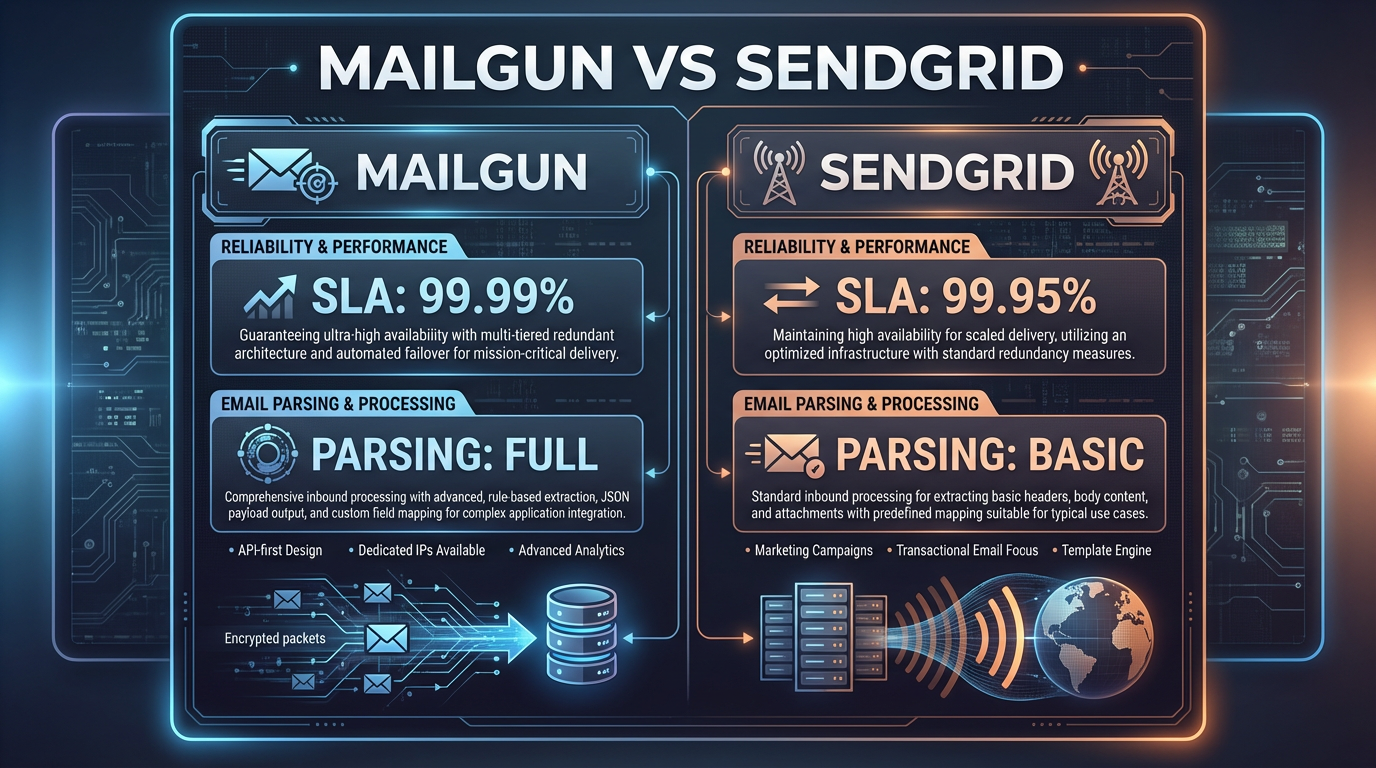
What is the core difference between Mailgun and SendGrid?
Mailgun belongs to Sinch. SendGrid belongs to Twilio. That ownership divergence over the past five years explains where each platform invested: Mailgun put resources into webhook reliability and inbound parsing; SendGrid layered marketing automation and Twilio ecosystem bundling on top of its sending infrastructure.
The architectural difference surfaces in account structure. Mailgun ties sending reputation to your specific sending domain. SendGrid centralizes IP reputation across free-tier users on shared pools, which creates a contamination risk: if another sender on your shared IP triggers blocklisting, your deliverability suffers without any action on your part.
Mailgun vs Sendgrid || Which is Better? by Chris Tech Guide
For developers, the practical gap is this: Mailgun assumes you understand SMTP, DNS, and webhook idempotency. SendGrid assumes you want drag-and-drop templates and pre-built integrations. Neither assumption is wrong universally, but the mismatch determines whether you spend your time on integration work or on debugging infrastructure behavior you didn't expect.
Feature comparison
| Feature | Mailgun | SendGrid |
|---|---|---|
| Free tier limit | 100 emails/day | 100 emails/day |
| Uptime SLA | 99.99% | 99.99% |
| Claimed deliverability | 97.4% | Varies by plan and ISP |
| G2 rating | 4.5 | 4.0 |
| Trustpilot rating | 4.3 | 1.3 |
| Shared IP pools (entry) | Yes | Yes |
| Dedicated IP minimum | ~$80/month | ~$50–100/month |
| Webhook retry window | 24 hours | 24 hours |
| Inbound routing | Per-address, JSON payloads | Multipart parsing, batch webhooks |
| API latency target | Sub-200ms | ~500ms average |
| SMTP relay support | Yes (port 587) | Yes (port 587) |
| Parent company | Sinch | Twilio |
Note on ratings: G2 scores are sourced from aggregated user reviews. The Trustpilot divergence (4.3 for Mailgun, 1.3 for SendGrid) is particularly wide and correlates with documented support response time complaints across SendGrid review threads.
Pricing tiers and hidden infrastructure limits
Both platforms start at 100 emails per day on their free tiers. The free tiers are equivalent in volume, so the comparison shifts immediately to what happens when you scale past them.
Mailgun's Foundation plan handles 50,000 messages per month, with overages billed per thousand beyond that. SendGrid's first paid tier covers a similar volume range, priced slightly lower in entry cost. At moderate volume (50,000–100,000 messages), SendGrid's published per-message rate appears cheaper on paper. The gap closes at higher volumes, and pricing from both platforms changes frequently enough that checking each vendor's current pricing page before committing is worth the five minutes.
The more important cost factor at entry tiers is infrastructure isolation. Both platforms use shared IP pools at their entry-level plans. The difference is how they manage domain reputation within those pools. Mailgun associates your sending reputation with your domain and maintains separation between customer domains at the pool level. SendGrid's shared pools group free and low-tier customers together more broadly, which increases the likelihood that a neighbor sender's behavior affects your inbox placement with specific ISPs.
At paid tiers with dedicated IPs (starting around $50–80/month depending on the platform), this distinction largely disappears. But at entry pricing, you're not paying the same price for the same infrastructure risk profile, even if the nominal monthly cost looks similar.
Webhook payload size is another hidden constraint. SendGrid's Inbound Parse Webhook supports attachments up to 30MB. Mailgun's limits are lower and documented separately in their inbound routing specifications. If you're processing large document attachments through inbound email, verify the specific limits against your expected payload sizes before building the integration.
Inbound email parsing and routing capabilities
Mailgun routes inbound mail to webhooks with atomic message semantics: one email to user+tag@yourdomain.com triggers one webhook to your configured endpoint. The payload is a single JSON object containing the raw message content, sender, subject, and any attachments encoded inline. Your receiving endpoint handles one event per email.
SendGrid's Inbound Parse Webhook structures inbound email into multipart components and can send headers separately from body content. A 2MB PDF attachment may arrive as a distinct event requiring correlation with the parent message. This multipart model adds state management overhead: you need to track message IDs and reassemble components on your end before processing the complete email.
The practical consequence for support email automation or ticket ingestion is that Mailgun's atomic webhook model typically requires simpler receiving logic. One database insert per inbound email rather than a multi-step reassembly process.
Retry semantics differ in ways that matter for flaky endpoints. Both platforms retry failed webhook deliveries for 24 hours when your endpoint returns a 5xx response. Mailgun uses exponential backoff (retrying more aggressively in the first minutes after failure, then spacing out). SendGrid uses a more evenly distributed retry schedule. The specific intervals for both platforms are documented in their respective developer guides, and reading those before building your receiving endpoint will save debugging time later.
Mailgun also exposes the full MIME header set in its webhook payload, including DKIM and SPF verification results. SendGrid normalizes headers and stores DKIM/SPF results separately in their dashboard rather than in the webhook payload. If your workflow requires validating cryptographic signatures on inbound mail, such as fraud detection or compliance pipelines, Mailgun's raw header exposure simplifies that logic considerably.
Sendgrid vs Mailgun (2026) | Which is Better? by Software Scope
Webhook reliability, retry logic, and idempotency
Both platforms guarantee at-least-once webhook delivery, not exactly-once. If your endpoint returns 200 but crashes before finishing the database write, Mailgun or SendGrid may retry and send a duplicate event. This is not a bug in either platform; it is the standard trade-off in distributed systems. Your endpoint needs to handle it.
High-volume teams encounter this concretely: webhook events arriving two or three times in quick succession during brief network instability. Without idempotency guards, you double-count opens, create duplicate records, or miscalculate bounce rates.
The fix is straightforward. Store the event ID (Mailgun uses event_id; SendGrid uses message_id in bounce and complaint payloads) in your database when you process each event. On incoming webhooks, check whether that ID already exists. If it does, skip processing and return 200. This prevents duplicate processing without requiring changes to how either platform sends events.
Mailgun documents this requirement explicitly in its webhook reference. SendGrid embeds the message ID in payload examples but does not make the idempotency requirement as prominent in its documentation. Teams building on SendGrid without reading deeply into the delivery event payload spec often discover the gap through production data integrity issues rather than documentation.
Both platforms include HMAC-SHA256 signatures on webhook requests. Verify these before processing. An unverified webhook endpoint accepting arbitrary POST requests is an unrelated but real security gap.
Deliverability rates and shared IP pool assignment
Mailgun publishes a 97.4% deliverability rate. SendGrid does not publish a comparable figure publicly at the same level of specificity. Independent testing referenced in email infrastructure comparisons has documented higher inbox failure rates for Microsoft Outlook and Hotmail on SendGrid's shared IP pools compared to Mailgun's. These gaps tend to narrow or disappear with dedicated IPs on either platform.
The mechanism is the shared IP reputation problem. One customer on a shared IP sends to high volumes of invalid addresses. Microsoft's filters blocklist that IP. Every other sender on that IP loses Outlook delivery for the duration of the block, which can last 48–72 hours. The affected senders had nothing to do with the triggering event.
Mailgun's per-domain pool management reduces this exposure by separating sending domain reputation at the infrastructure level. It does not eliminate shared IP risk entirely at entry pricing, but it limits the blast radius of a neighbor sender's abuse. Teams who have switched between platforms for this specific reason report meaningful recovery in open rates for recipient lists heavy with Outlook and Hotmail addresses, though exact figures depend on list composition and prior sending history.
Both platforms offer dedicated IPs that remove shared pool risk entirely. If your sending volume justifies the cost ($50–80/month depending on the platform), dedicated IPs are the cleanest solution to deliverability unpredictability on either service.
Bounce handling differs in a way that matters at scale. Mailgun automatically marks addresses as invalid in real-time after a hard bounce and prevents future sends to that address within the same domain. SendGrid's suppression system also automatically handles bounces, but the real-time domain-level integration is less immediate. For high-frequency transactional sending where the same invalid address might be triggered multiple times in a short window, Mailgun's bounce suppression reduces repeated delivery attempts more aggressively.
Complaint handling: both platforms track abuse reports from ISPs and will suspend or restrict accounts that exceed complaint thresholds. Mailgun's account protection is more automated at the domain level. SendGrid's threshold enforcement follows Twilio's deliverability policies. Read the enforcement documentation for whichever platform you use before you start sending at volume.
How support SLAs and uptime commitments compare
Both Mailgun and SendGrid publish 99.99% uptime SLAs. At that SLA level, permitted annual downtime is under an hour. The SLA parity means infrastructure uptime is not a differentiator for most teams; support responsiveness is.
G2 ratings (Mailgun 4.5 vs SendGrid 4.0) and Trustpilot ratings (Mailgun 4.3 vs SendGrid 1.3) tell the same story: support experience drives the gap. SendGrid review complaints concentrate on response delays, routing through generalist Twilio support agents, and difficulty reaching email-specific expertise. Mailgun complaints concentrate on pricing or feature requests rather than support quality.
For developers, the support latency question is irreversible under pressure. A delivery outage at 2am that waits 48 hours for a first response costs real money on password reset emails, payment confirmation messages, or any transactional flow where timing affects user behavior. Mailgun's direct technical support channels (email and chat for standard tiers, faster response for enterprise) have a documented reputation advantage over SendGrid's Twilio-routed queue.
If you are evaluating both platforms and support responsiveness matters to your use case, read recent support-related reviews on G2 and Trustpilot before deciding. The ratings are aggregated and reflect thousands of developer experiences.
Is Mailgun better than SendGrid for developers?
For most transactional use cases, yes.
Choose Mailgun when:
- Your primary sending pattern is event-driven and API-initiated (password resets, notifications, confirmations)
- You need inbound email routing with atomic JSON webhook payloads
- Sub-200ms API latency matters for your user-facing flows
- You want direct technical support with documented response time expectations
- You are building on a single sending domain and want clean reputation isolation
Choose SendGrid when:
- Your team is already embedded in the Twilio ecosystem and consolidating on one vendor reduces operational overhead
- Non-technical team members need drag-and-drop campaign builders for marketing sends
- You send high-volume newsletters with visual template requirements
- You need pre-built Twilio integrations (SMS, voice, chat) alongside email
Most SaaS products send both transactional and marketing email. If the split is 70% transactional or heavier, Mailgun's architecture fits better. If it is 70% marketing volume driven by non-technical users, SendGrid's UI scales more efficiently for that workflow.
Cost analysis needs to account for deliverability impact, not just monthly invoice totals. An entry-tier account with degraded Outlook inbox placement on a contaminated shared IP has a real cost per missed delivery: a failed password reset generates a support ticket, account lockout, and potential churn. That cost exceeds the monthly price difference between plans. Build in a deliverability monitoring tool regardless of which platform you choose, and treat inbox placement rates as a business metric alongside opens and clicks.
For new projects without existing vendor lock-in, Mailgun's developer experience and reputation isolation justify its pricing at the lower tiers. For teams already standardized on Twilio infrastructure, SendGrid's ecosystem integration may outweigh its support experience gap. At 1 million or more messages per month, both platforms converge in capability and cost, making the decision primarily about team tooling preferences and support expectations.
SendGrid vs Mailgun vs Mailchimp (2026) - Which One Is BEST? by Paperclick
Related Reading
- Mailgun vs SendGrid: Detailed Comparison – Feature-by-feature breakdown of both platforms
- Transmit vs Mailgun - Email Platform Comparison – How Transmit stacks up against Mailgun
- SendGrid vs Transmit: Key Differences – When to consider alternatives to SendGrid
- Postmark vs SendGrid Comparison – Another developer-focused alternative
- Resend vs SendGrid Comparison – Modern email API alternatives
Frequently asked questions
Which platform has better inbox placement?
Mailgun publishes 97.4% deliverability across all ISPs. SendGrid does not publish a comparable public figure. Independent testing in email infrastructure comparisons has documented higher inbox failure rates for Microsoft Outlook and Hotmail on SendGrid's shared IP pools relative to Mailgun. Dedicated IPs on either platform significantly improve inbox placement by removing shared pool contamination risk.
Can I use Mailgun or SendGrid for bulk marketing email?
Yes, both support bulk sending. Mailgun prioritizes transactional throughput over marketing templates. SendGrid's drag-and-drop builder and segmentation tools are better suited to marketing workflows. If your sending is 80% marketing volume managed by non-technical users, SendGrid's UI is more efficient. If it is 50/50 or transaction-heavy, Mailgun's unified API handles both without requiring a separate marketing tool.
How do I avoid webhook duplication issues?
Store the event_id (Mailgun) or message_id (SendGrid) in your database when you process each webhook event. On incoming events, check whether that ID already exists before processing. If it does, skip processing and return 200. Both platforms retry webhooks for 24 hours, so this idempotency guard is essential for accurate delivery metrics and data integrity.
What is the cheapest way to scale to 1 million emails per month?
Both platforms offer volume pricing at that level. Mailgun's per-thousand rate at high volume tends to be competitive with SendGrid's standard plans. Check current pricing directly with each vendor: both have changed their pricing structures in recent years and the specific tier breakpoints shift. Factor dedicated IP cost into your calculation if you are on shared pools at entry tiers, since deliverability differences can affect revenue metrics beyond the raw email cost.
Does Mailgun handle bounces automatically?
Yes. Mailgun automatically processes hard bounces and marks addresses invalid in real-time, preventing future sends to that address within the same domain. SendGrid also suppresses bounced addresses, though Mailgun's real-time domain-level suppression is more aggressive in preventing repeated delivery attempts to the same invalid address in a short window. Both platforms maintain suppression lists, but the implementation timing differs.
Which platform integrates better with my tech stack?
Mailgun has strong SDK coverage for common backend languages including Node.js, Python, Ruby, PHP, and Go. SendGrid has comparable SDK coverage and adds pre-built integrations with Twilio's broader product suite. For pure API integration, both are functionally equivalent. If your stack includes other Twilio products, SendGrid simplifies authentication and billing consolidation. If it does not, this is not a meaningful differentiator.
What happens if my IP gets flagged for spam?
On shared pools, both platforms manage IP reputation at the infrastructure level, though Mailgun's per-domain isolation limits the impact of neighbor sender abuse more than SendGrid's broader pool grouping. On dedicated IPs, your domain reputation is entirely your own. Both platforms will restrict sending on accounts that exceed complaint thresholds. Review each platform's abuse enforcement policies before you start sending at volume.
Can I use either platform with my existing email domain?
Yes. Both require DKIM, SPF, and DMARC DNS records. Domain verification on Mailgun typically completes in 12–24 hours after DNS propagation. SendGrid verification can take 24–48 hours. Both provide DNS configuration guides and validation tools in their dashboards.