Postmark became the default for developers who wanted reliability without self-managing Amazon SES. That advantage has eroded. Postmark caps data retention at 45 days, prices by volume with limited flexibility at scale, and keeps transactional sending siloed from any marketing workflows. Teams scaling past 50,000 emails monthly are increasingly finding that managed alternatives offer comparable reliability at a lower total cost.
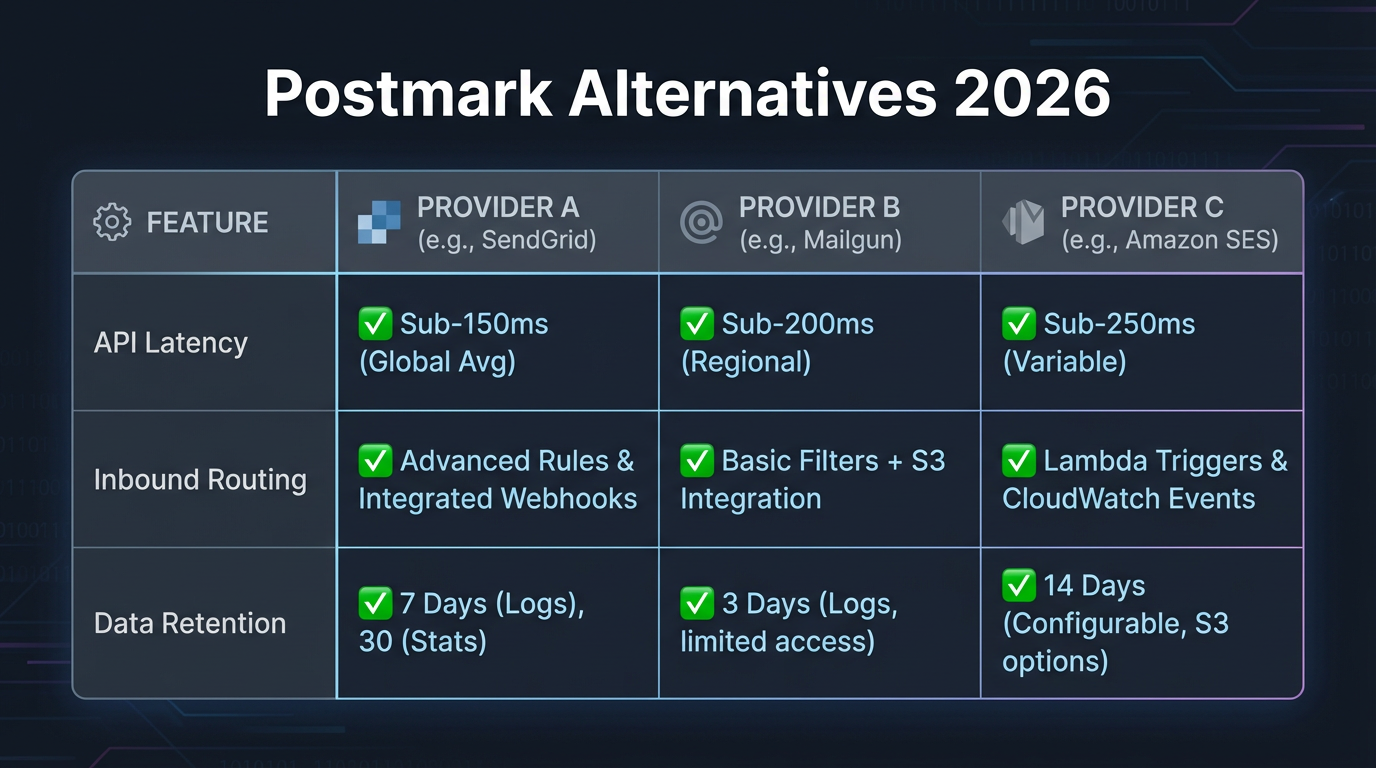
The real decision is not just price. It is latency profiles, inbound email handling, and the operational friction of switching infrastructure mid-product. This guide compares nine transactional email providers on the metrics that matter to developers: API latency under load, webhook structure for inbound handling, data retention windows, and the cost-versus-feature tradeoffs at meaningful send volumes.
Why developers are looking for Postmark alternatives in 2026
Developers migrate from Postmark for three concrete reasons. First, the 45-day data retention window creates compliance friction for teams that need 90-day or longer audit trails for financial notifications, authentication workflows, or customer communications. Whether Postmark extends this window on request is not publicly documented, so teams with hard retention requirements cannot plan around it.
Second, Postmark is transactional-only. There are no marketing sends, no broadcast emails, and no unified API for combining message types. A team that starts with Postmark for password resets and later needs to send onboarding sequences must introduce a second platform, manage two sets of credentials, and maintain two webhook integrations. Platforms that unify transactional and marketing email under a single API eliminate that operational split.
Third, pricing at scale deserves honest math. Postmark's base plan starts at $15/month for 10,000 emails, with overages billed per thousand sent. At 100,000 emails monthly the cost is roughly $100 depending on the plan tier. Some alternatives reach the same volume for less, though the gap is narrower than many comparisons suggest and depends heavily on which managed features you actually need. Research from Moosend highlights Postmark's recent pricing changes and cost comparisons at scale.
Comparing Resend, Postmark & Loops - Email APIs for SaaS by PlanetNoCode
How we evaluated these transactional email providers
Evaluation focused on four dimensions that migration decisions hinge on. First, API latency under baseline load. Most providers do not publish latency baselines, which creates real opacity when sizing infrastructure for signup flows or notification spikes. Where providers disclose latency, those numbers are noted; where they do not, that absence is flagged.
Second, inbound email handling. Postmark parses incoming mail into structured JSON with multipart MIME decomposition. Many competitors treat inbound as an add-on or require external parsing libraries. This matters because teams using Postmark for transactional sends often adopt inbound for support routing, bounce handling, or reply workflows.
Third, data retention and compliance windows. Retention periods range from 7 days to configurable unlimited, and this directly affects debugging, forensics, and audit requirements.
Fourth, migration effort. API surface area drives friction. Endpoint changes with SMTP compatibility preserved mean lighter migration. Divergence on metadata fields, webhook payload structure, or domain configuration scales integration work significantly.
| Provider | Starting price | API latency | Inbound parsing | Data retention | Best for |
|---|---|---|---|---|---|
| Amazon SES | $0.10/1K emails | Not disclosed | Manual (S3/SNS/Lambda) | Configurable via S3 | Cost-sensitive high-volume senders on AWS |
| Resend | Free (3K/month) | Not disclosed | Limited (manual webhook) | 7 days | React-first developers |
| Mailgun | Free (100/day) | Not disclosed | Native MIME parsing | Varies by plan | Experienced engineering teams, EU data residency |
| SendGrid | $15/month | Not disclosed | Native inbound parse | 30 days (transactional) | Large-scale operations or legacy integrations |
| Mailtrap | $30/month | Not disclosed | Full MIME parsing | Varies by plan | Deliverability-focused workflows |
| Brevo | From ~$9/month | Not disclosed | Native (Mail API) | 45 days | Multi-channel (SMS/WhatsApp) requirements |
| MailerLite | Free (marketing tier) | Not disclosed | Marketing-focused | Varies | Email marketing with basic transactional |
| SparkPost | Custom (enterprise) | Not disclosed | Full MIME parsing | Varies | High-deliverability enterprise environments |
| Transmit | Usage-based | Sub-200ms (transactional) | Webhook routing | 7 days (standard) | AWS-native teams needing unified transactional and inbound |
Amazon SES: The baseline for raw infrastructure cost
Amazon SES is the floor for email infrastructure cost. At $0.10 per 1,000 emails, a team sending 500,000 emails monthly pays $50 in base sending fees. Postmark at the same volume costs significantly more once volume tiers and overages are factored in. The math favors SES by a wide margin at scale.
The tradeoff is operational. SES requires managing sending limits, warm-up procedures, bounce handling, complaint monitoring, and dedicated IP provisioning separately. None of these come with the base service. Achieving Postmark-level deliverability on SES requires external tooling for domain reputation management, IP rotation, and suppression list hygiene.
Dedicated IPs on SES cost $24.95 per month each. A team managing reputation isolation across multiple customer bases needs at least one dedicated IP per customer cohort, adding $25 to $100 per month in IP costs alone. Inbound email on SES requires configuring S3 buckets for receipt, SNS topics for routing, and Lambda functions to parse MIME. Total cost is low, but integration complexity is high.
SES works best for teams already on AWS, comfortable with infrastructure-as-code, or large enough to justify dedicated DevOps time for email plumbing. Teams without that profile incur hidden engineering costs that erode the savings.
Resend: The modern choice for React developers
Resend was built to pair React Email templating with transactional delivery. Templates live in JavaScript rather than external design tools, so developers and designers collaborate without context-switching between systems.
Resend's free tier provides 3,000 emails monthly with a hard cap of 100 emails per day on shared infrastructure. This is restrictive for production but workable for staging. The Pro plan at $20/month removes the daily cap and allows up to 50,000 emails monthly, with overages at $0.90 per 1,000 emails beyond the tier limit.
API latency is not publicly disclosed. Resend uses modern edge infrastructure and serves global customers, but no published baseline exists for comparison.
Inbound email parsing is minimal. Resend's inbound feature requires manual webhook integration with third-party parsing libraries, unlike Postmark's structured JSON decomposition. For teams that only need transactional sends, this is irrelevant. For teams using reply handling or bounce routing, it adds development debt.
Data retention is 7 days, among the shortest in the market. Compliance-heavy use cases will need a different provider.
Resend is the practical choice for Next.js teams and React Email users prioritizing developer experience. For use cases that require operational breadth, the integrations feel forced.
NEW Postmark vs Amazon SES — Best High-Delivery Transactional Email for Startups by How2Genius*
Mailgun: The high-volume API with localized European data routing
Mailgun handles billions of emails annually and is the veteran alternative to SendGrid for developers who want API flexibility without fully managing infrastructure. The platform supports both HTTP REST and SMTP, accommodates custom sending domains at scale, and preserves raw control over sender configuration.
Pricing starts free at 100 emails per day. Paid plans scale based on monthly volume, with per-thousand rates that decrease as volume grows. The exact overage rate on Scale plans is lower than $1.80 per thousand based on Mailgun's published tiers, though the precise number depends on contracted volume.
Mailgun's explicit US and EU data residency options are its clearest differentiator for compliance-sensitive teams. Postmark's data processing is U.S.-based with no publicly documented option for EU-only routing, which creates friction for GDPR compliance in some jurisdictions. Mailgun solves this by allowing teams to choose their region at account setup.
Inbound email handling is robust. Mailgun's Inbound Routes feature accepts incoming mail via MX records and forwards to webhooks with full MIME parsing, multipart decomposition, and attachment extraction. This is comparable to Postmark's inbound capability.
Mailgun works well for teams needing localized data handling, running high-volume workloads, or comfortable managing sender reputation manually. The control depth is greater than SendGrid, but the learning curve reflects that.
SendGrid: The legacy scale option with integrated marketing
SendGrid remains a practical choice for organizations already running on its platform. The Mail Send API is mature, documentation is thorough, and support response times are generally good at paid tiers.
The main concern for pure transactional use is shared IP pool reputation. SendGrid's shared infrastructure is used by a wide range of senders, and shared pools can carry deliverability risk if other senders on the same IPs generate complaints or bounces. This is not unique to SendGrid, but it is more pronounced on platforms with large, diverse customer bases. Dedicated IPs are available on higher tiers and significantly reduce this exposure.
Pricing starts at $15/month for the Essentials plan. Data retention for transactional events is 30 days on standard plans. Inbound email parsing is available via the Inbound Parse webhook, with a structure similar to Mailgun's.
SendGrid advertises 99.99% uptime, verifiable via their public status page. The platform's uptime record is generally strong.
Use SendGrid when you are already entrenched in their ecosystem or need deep integration with their marketing automation features. For standalone transactional work starting from scratch, the shared IP risk and pricing make alternatives worth evaluating first.
Mailtrap: The deliverability testing platform turned sender
Mailtrap started as an email sandbox tool for staging environments and evolved into a full sending platform. That heritage shapes its positioning: the company focuses on inbox placement diagnostics and delivery testing rather than raw throughput.
The sending API supports custom headers, templates, batch sends, and full MIME control. Inbound email handling is available with complete MIME parsing and attachment extraction.
Pricing starts at $30/month for the Business plan, which includes 100,000 emails. That is a higher per-email cost than usage-based competitors. For context, $30 for 100,000 emails is $0.30 per thousand. Mailgun's paid plans reach similar volume at lower per-message rates, but Mailtrap's pitch is that its inbox placement diagnostics catch delivery problems early, reducing the cost of undelivered mail rather than just minimizing the cost of sending. Mailtrap's testing approach focuses on deliverability expert insights and infrastructure analysis.
Mailtrap is a reasonable fit for ecommerce and SaaS teams where undelivered emails directly harm revenue, such as order confirmations, password resets, and billing alerts. The diagnostics justify the premium if your team is actively tracking inbox placement. For teams that just need to send at volume, cheaper options exist.
Mailtrap and Postmark API compared: which one is better? by Mailtrap
How to migrate your email API from Postmark
Migration requires mapping three layers: DNS configuration, API endpoints, and webhook payloads.
The DNS layer is the most straightforward. Most providers accept standard DKIM, SPF, and DMARC record formats, though DKIM selector names and signature alignment requirements can vary. Verify your domain on both Postmark and the target platform in parallel before cutting over. Switching MX records while old records are still live avoids a delivery gap; removing Postmark records before the target records propagate creates a window of up to 15 minutes where inbound mail fails.
The API layer is where friction concentrates. Postmark's transactional API sends to https://api.postmarkapp.com/email with JSON fields like From, To, Subject, and HtmlBody. Resend uses https://api.resend.com/emails with a nearly identical JSON structure, making it the lowest-friction endpoint switch. Mailgun uses form-encoded multipart data sent to region-specific endpoints, which requires more integration rework.
SDK compatibility varies. If you built on Postmark's official SDK, migrating requires rewriting integration points for any platform with a different SDK. If you built directly on REST HTTP calls, endpoint changes are minimal.
Webhook payload structures differ across providers. Postmark's bounce and delivery events use a specific JSON schema with event type, delivery status, and metadata. Mailgun and SendGrid use different schemas. A webhook handler built for Postmark will not parse competitor events without adapter code.
The practical approach for most teams: switch endpoints directly rather than adding an abstraction layer. Abstraction libraries reduce provider lock-in but add complexity and maintenance surface. For small teams, direct switching and adapter code for webhooks is faster.
Test migration in staging first. Send at least 10,000 messages through the target platform over 48 hours. Monitor bounce rates, delivery delays, and webhook event firing. Then schedule a production cutover.
Is Amazon SES cheaper than Postmark at scale?
At 100,000 emails monthly, the math is straightforward.
Postmark's base plan starts at $15/month for 10,000 emails. Overages above that are billed per thousand, and total cost at 100,000 emails lands around $100/month depending on the applicable tier rate.
Amazon SES at 100,000 emails costs $10 in base sending fees (100 x $0.10). Add one dedicated IP at $24.95 and total monthly cost is roughly $35. If reputation isolation requires two IPs, add another $25, bringing the total to about $60.
At 500,000 emails monthly, SES base sending fees are $50. With two dedicated IPs the total is approximately $100/month. Postmark at the same volume escalates considerably as overage rates apply across a larger message count. Sender.net's analysis focuses on operational simplicity for teams that find Postmark's developer-only focus limiting.
Mailgun's paid tiers at 500,000 emails cost more than SES but less than Postmark at equivalent volume, with the trade being managed deliverability tools versus raw per-message cost.
The SES advantage is mathematical and grows with volume. The hidden cost is DevOps engineering for reputation management, warm-up, and suppression list compliance. Teams already on AWS with infrastructure engineering capacity will find SES decisive on cost. Teams without that capacity will find managed platforms bridge the gap without requiring dedicated email infrastructure expertise.
Frequently asked questions
What is the fastest API latency for transactional email?
Few providers publish baseline API latency numbers. Postmark's marketing historically emphasizes fast time-to-inbox delivery, though specific millisecond API response targets are not published with defined load conditions. Most platforms cluster between 200ms and 500ms in real-world conditions depending on region, payload size, and server load. If sub-200ms API latency is a hard requirement, verify it directly with providers under your expected load profile before committing.
Can I use Mailgun or SendGrid as a direct Postmark replacement?
Both platforms support HTTP REST APIs and SMTP relay, so endpoint switching is technically straightforward. The friction is in webhook payload differences for inbound events and management dashboard workflows. If you built on Postmark's official SDK, expect to rewrite integration points. If you built on direct REST calls, changes are minimal. Plan extra time for webhook adapter code regardless of which platform you choose.
How long do email logs retain with each provider?
Postmark retains full message storage for 45 days. Amazon SES is configurable via separate log forwarding to S3, with no fixed ceiling. Resend retains for 7 days. SendGrid retains transactional event logs for 30 days on standard plans. Mailgun and Mailtrap retention varies by plan tier. If you need 90-day or longer audit trails for compliance, SES with S3 forwarding is the only out-of-the-box option that scales to arbitrary retention windows.
Is there a Postmark alternative with inbound email parsing?
Mailgun, SendGrid, and Mailtrap all support inbound email receipt and MIME parsing natively. Resend's inbound feature requires manual webhook integration with external parsing libraries. The most complete structured decomposition into JSON fields, including multipart MIME and attachment extraction, comes from Mailgun and the legacy Postmark inbound implementation.
What is the cheapest alternative to Postmark?
Amazon SES is cheapest by raw per-message cost at $0.10 per 1,000 emails, but requires self-managing reputation, warm-up, and compliance tooling. Mailgun's paid tiers are the most cost-effective managed alternative that includes reputation automation, though exact per-thousand rates depend on contracted volume. Usage-based platforms generally outperform flat-rate plans once monthly send volume exceeds 100,000 emails.
Can I test changes to my email provider in staging?
Yes. Configure both Postmark and your target provider in parallel in staging. Send test volume through the new provider, verify webhook firing, monitor bounce rates, and inspect delivered email rendering across major mailbox providers including Gmail, Outlook, and Yahoo. After 48 hours of stable delivery without anomalies, schedule the production cutover during a low-traffic window if possible.
Related Reading
- Best Resend Alternatives in 2026 (Ranked) – Explore top alternatives to Resend for transactional email.
- Best SendGrid Alternatives in 2026 (Ranked) – Compare SendGrid alternatives for scalability and features.
- Best Mailgun Alternatives in 2026 (Ranked) – Discover Mailgun alternatives with competitive pricing and features.