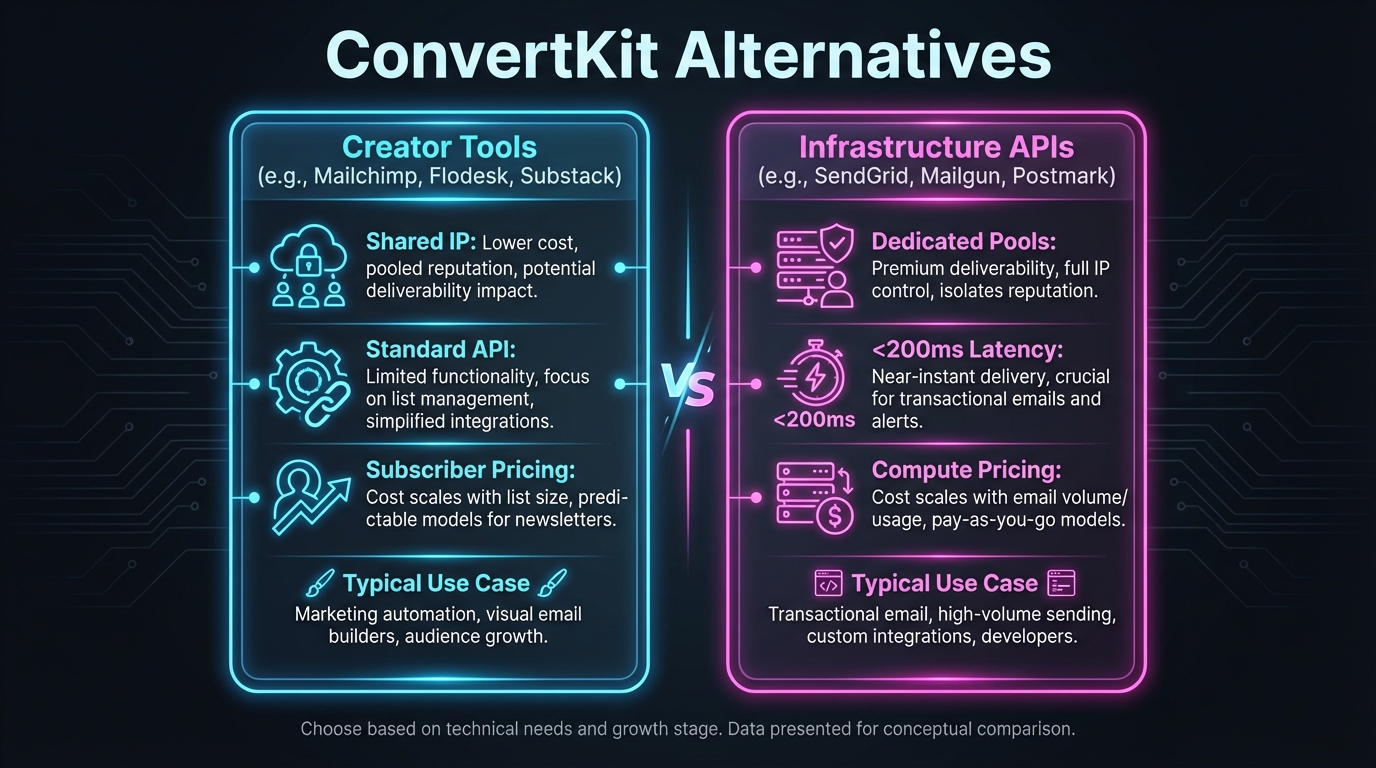
A technical ConvertKit alternative is an email delivery platform designed for software teams and SaaS companies rather than individual creators. Unlike Kit (formerly ConvertKit), which optimizes its interface for newsletter writers and solopreneurs, technical alternatives prioritize API latency, webhook event routing, reputation isolation per domain, and infrastructure control through bring-your-own-key (BYOK) AWS integration. This distinction matters because creator-focused ESPs route emails through shared sending pools that can expose growing SaaS platforms to reputation damage from other senders on the platform. They also lack the sub-200ms transactional API speeds required for authentication flows, password resets, and real-time notifications in modern applications.
What is the best technical ConvertKit alternative for SaaS?
The best technical ConvertKit alternative depends on whether your SaaS platform prioritizes raw infrastructure cost, webhook event density, or transactional speed.
If you are sending millions of emails monthly and want to avoid vendor lock-in, platforms offering BYOK AWS integration let you pay at raw compute margins. AWS SES pricing is $0.10 per 1,000 emails, so 1 million emails per month costs roughly $100. If you need low latency for transactional flows like OTP delivery or payment confirmations, developer-first platforms with dedicated transactional APIs outperform Kit's general-purpose sender. If you operate a multi-tenant SaaS where each customer's sending reputation must be isolated so that one customer's spam complaints do not affect delivery rates for others, per-domain reputation isolation becomes a table-stakes requirement.
Kit targets creators managing a single sender identity. It bundles email delivery with a landing page builder, a Creator Network for recommendations, and integrations designed for writers and small business owners. For this audience, Kit's simplicity and visual email editor are genuine advantages. For SaaS teams, they are friction. When a startup scales beyond 10,000 subscribers or when a SaaS product requires transactional emails alongside marketing campaigns, Kit's architectural constraints become expensive to work around.
5 best email marketing platforms in 2026 | ActiveCampaign vs. Kit (ConvertKit) vs. Mailerlite by Wit & Wire | Course Creation Tips ✨
Why growing software teams outgrow Kit (formerly ConvertKit)
Kit operates on shared sending infrastructure. Each email you send routes through a pool of IPs managed by Kit. While this simplifies IP warmup for new senders, it creates a noisy-neighbor problem: if another sender on Kit's platform has poor list hygiene or sends content that triggers spam filters, the shared IP reputation can suffer across the pool. Google and Yahoo published bulk sender authentication requirements in early 2024, tightening DMARC alignment, SPF, and DKIM signing standards. When a shared IP accumulates negative signals, all senders routed through that IP face potential delivery degradation until reputation recovers.
Kit also does not separate transactional and marketing sends into distinct queues. Password reset emails, one-time password (OTP) delivery, and payment confirmation notifications route through the same general-purpose sender as newsletters. Platforms built specifically for transactional delivery optimize for single-send request handling and prioritize those requests above batch marketing sends. For a checkout page or login flow, even a few hundred milliseconds of added latency is user-facing friction that increases abandonment.
Kit's webhook event coverage skews toward broadcast use cases. It fires events for opens, clicks, bounces, and unsubscribes, but granular complaint signals and per-recipient suppression status are not exposed in the same way developer-focused platforms handle them. Multi-tenant SaaS platforms often need per-customer webhook routes: one customer's delivery events should reach their webhook endpoint without mixing with another customer's events. Kit's model does not support this natively, which forces teams to build filtering and re-routing logic themselves.
Kit also does not offer BYOK functionality. You cannot connect your own AWS SES account and maintain control over your sending infrastructure. If a security event occurs or you decide to migrate, you are rebuilding credential management from scratch. Platforms that support BYOK typically allow IAM role setup in under two minutes, support instant credential revocation, and impose no data lock-in when you decide to leave.
API performance and scaling: comparing top delivery engines
API latency is the time from your application's HTTP request to confirmation that the email has been queued by the provider's sending infrastructure. Transactional emails demand low latency; marketing campaigns do not. Because Kit does not separate transactional and marketing senders, all emails compete for the same queue, which adds measurable wait time during high-volume broadcast periods.
Postmark is well-regarded for transactional latency and its API accepts both single-email POSTs and batches. Resend is a JavaScript/TypeScript-native platform that targets minimal API response times by running endpoints closer to the request origin. SendGrid covers the widest range of language SDKs and integrations, making it a common default for engineering teams that need to move fast across multiple backend languages. Each of these represents a step up from Kit's general-purpose sender for teams that care about transactional performance.
BYOK and infrastructure control differ sharply across these options. Kit does not support BYOK. Postmark runs on its own infrastructure and does not allow raw AWS access. Resend similarly manages its own sending layer. SendGrid does not offer BYOK on standard plans. Only a small set of providers offer direct AWS IAM role integration. This matters most for teams with compliance requirements such as SOC 2 or HIPAA, custom data loss prevention rules, or geographic data residency mandates. For those teams, the ability to connect an existing AWS account, encrypt credentials with AES-256, and revoke access instantly is not a nice-to-have; it is an architectural requirement.
SDK coverage is a practical integration consideration. Postmark supports a wider range of languages than Kit, including Go, which is relevant for microservice architectures common in SaaS backends. Resend is strongest for JavaScript and TypeScript ecosystems. SendGrid covers the broadest set of languages. For a Python-first or Go-first backend, the choice of provider affects how much integration work lands on your team.
Top 5 ConvertKit Alternatives for Email Marketing in 2024 by EngageBay
How does reputation isolation work compared to shared creator pools?
Reputation isolation is the practice of giving each sender, or each customer in a multi-tenant SaaS, a dedicated sending pool so that one sender's spam complaints or bounce rates do not degrade another sender's inbox placement. Kit uses a shared pool model, meaning creators on Kit share the same set of sending IPs.
Under Google and Yahoo's 2024 authentication standards, reputation metrics are evaluated at the domain level. If your SaaS platform's customer sends content that triggers spam complaints, Google evaluates the sending domain's reputation. However, if the underlying IP infrastructure carries negative signals from other senders, email routed through that IP faces secondary filtering. For a SaaS platform growing from 10 customers to 100, any one customer with poor list hygiene can generate shared infrastructure reputation damage that affects the other 99.
Per-domain reputation isolation addresses this by assigning each customer (or each distinct sender domain) a dedicated sending pool. Each customer's emails route through a separate pool managed by a per-customer reputation service. Domain warmup under this model auto-increments daily sending limits gradually and pauses the ramp if bounce rates exceed defined thresholds. This prevents one customer's problematic send from contaminating another's domain reputation.
Postmark offers dedicated IPs at a premium, but does not provide per-customer isolation within a single account. If you operate a SaaS where your customers send emails through your Postmark account, you cannot separate their reputations. Resend is single-tenant per API key, meaning each of your customers would need a separate Resend account, which adds significant administrative overhead and makes per-customer webhook routing difficult to manage.
What are the best Mailchimp alternatives for combined marketing and transactional email?
Searchers often group Kit and Mailchimp together because both serve small business owners and creators. Mailchimp started as an email marketing platform and added transactional features later as a separate product (Mandrill). The result is that teams using Mailchimp for marketing often maintain a second provider for transactional sends, which creates duplicate template libraries and split contact records.
Platforms that unify marketing and transactional email allow a single template library, a merged contact management system, and unified event tracking. Liquid templating, for example, lets both a transactional OTP email and a weekly digest use the same template syntax with merge tags. Postmark supports Liquid templating across transactional and marketing sends. SendGrid uses Handlebars templating. Mailchimp uses a custom template syntax that does not map cleanly to transactional APIs, so teams often end up maintaining two separate template systems in parallel.
Contact management is a persistent pain point. Mailchimp stores contacts in broadcast lists. Transactional emails like order confirmations route to ephemeral recipients that are not automatically added to a list. Teams end up syncing email addresses into Mailchimp manually and accumulating duplicate records. Platforms built for SaaS can pull user records from auth providers (Clerk, Auth0, Supabase) on a scheduled basis, create or update contacts automatically, and organize them with custom fields for segmentation without manual intervention.
For onboarding email sequences, Mailchimp offers automation journeys, but the GUI-heavy workflow introduces latency between steps that can run into minutes. SaaS-focused platforms support sequences with configurable delays and API-triggered entry points, which matters during signup flows when users expect responsive communication.
Other alternatives worth evaluating for combined use cases include Brevo (formerly Sendinblue), which uses volume-based pricing and includes both marketing and transactional sends under the same account, and GetResponse, which supports marketing automation alongside transactional delivery. According to research from mailerstack.com, future-looking alternatives for 2026 emphasize business needs like migration processes and delivery infrastructure.
Evaluating pricing models: subscriber lists versus compute volume
Subscriber-list pricing is Kit's model. You pay per contact stored on your list, whether or not those contacts are active senders. Kit's Creator plan is approximately $119 per month at 10,000 subscribers. The cost is predictable but scales with list size rather than with how much email you actually send.
Volume-based pricing charges per email sent rather than per subscriber stored. Brevo's free plan includes 300 emails per day (roughly 9,000 per month). For a SaaS platform storing a large contact database but sending relatively few emails each month, volume pricing can be substantially cheaper. A platform with 50,000 contacts but sending only 10,000 emails per month would pay near nothing under volume pricing while paying several hundred dollars monthly under subscriber-list pricing.
Compute-based pricing applies when you connect your own AWS SES account through BYOK. AWS SES charges $0.10 per 1,000 emails sent. At 1 million emails per month, that is $100. At 5 million emails per month, the cost is $500, compared to subscriber-list pricing that would charge based on your total contact count regardless of send volume. The savings compound as volume grows, and the cost structure aligns with actual usage rather than database size.
For a startup with a large contact database but low monthly send volume, volume-based or compute-based pricing will typically cost less than subscriber-list pricing. The math reverses if you have a small, highly active list: a creator with 1,000 engaged subscribers sending a daily newsletter may find Kit's pricing competitive precisely because list-based pricing is predictable at that scale. Sender.net's detailed breakdown highlights how migration processes and delivery infrastructure impact long-term costs.
Comparison: Kit versus technical alternatives
The table below summarizes the key infrastructure and capability differences across the platforms discussed. Note that specific latency benchmarks vary by implementation, and features marked for developer-first alternatives reflect capabilities found in platforms purpose-built for multi-tenant SaaS rather than any single provider.
| Feature | Kit | Postmark | Resend | SendGrid | Multi-tenant SaaS platforms |
|---|---|---|---|---|---|
| Transactional queue separation | No | Yes | Yes | Yes | Yes |
| Per-domain reputation isolation | No | No (account-level) | No (per API key) | No | Yes |
| BYOK AWS integration | No | No | No | No (standard plans) | Yes |
| Domain warmup with auto-pause | No | No | No | No | Yes |
| Webhook events | Opens, clicks, bounces, unsubscribes | Delivery, opens, bounces, complaints | Delivery, opens, bounces | Delivery, opens, bounces, complaints | Per-customer routing with complaint signals |
| Liquid templating | Yes | Yes | No | No (Handlebars) | Yes |
| Auth provider sync | No | No | No | No | Yes |
| Email sequences | Yes | No | No | Yes | Yes |
| Pricing model | Per subscriber | Per send | Volume-based | Subscriber/volume mixed | Volume-based or BYOK raw AWS rates |
Which should you choose?
Choose Kit if you are a creator or writer with fewer than 5,000 subscribers and no transactional email requirement. Kit's editor and landing page builder are built for newsletters. You do not need infrastructure control or multi-tenant isolation, and the interface is simpler than Postmark or SendGrid.
Choose Postmark if you run a SaaS with transactional email needs but do not require per-customer reputation isolation. Postmark's transactional performance is well-regarded, and its templating is flexible. You accept that all your customers' emails share a single account reputation, which works for SaaS applications where you manage deliverability centrally.
Choose Resend if your team is JavaScript or Next.js-first and transactional latency is the primary concern. Resend does not offer per-customer reputation isolation; each customer would need a separate API key and account, which adds operational overhead as you scale.
Choose SendGrid if you need broad SDK language support and integrations with CRM and marketing platforms. SendGrid is a common choice for large engineering teams. Volume-based pricing and advanced segmentation make it practical for high-volume sends, though it does not offer BYOK on standard plans.
Choose a multi-tenant SaaS email platform if you need per-customer reputation isolation, BYOK AWS integration, and a unified system for both marketing and transactional email. Transmit, for example, provides per-domain sending pools, one-click AWS IAM role setup, and domain warmup with auto-pause on bounce rate spikes, which eliminates the manual monitoring that shared-pool platforms require. The trade-off compared to SendGrid is a smaller third-party integration ecosystem; if deep CRM connectors are a hard requirement, verify specific integration support before committing.
Why I Switched from Convertkit to Flodesk by Phil Pallen
The infrastructure gap matters more than the interface
Most comparisons focus on visual features like email editor design, template libraries, and automation UI, because they are easy to screenshot and rank. The infrastructure gap is harder to spot until you scale. A creator with one sender identity and a modest subscriber count can use Kit indefinitely without hitting a ceiling.
A SaaS platform scaling to multiple customers will encounter Kit's architectural limits: no per-domain reputation isolation, no BYOK, no dedicated transactional queue. These are not edge cases; they are predictable consequences of using a creator-focused tool for multi-tenant application email.
The choice between Postmark, Resend, SendGrid, and specialized SaaS email providers comes down to infrastructure priorities. For raw cost benefits through BYOK, only a handful of providers offer it. For the fastest transactional handling, Resend and Postmark are the leading options among general-purpose tools. For the broadest integrations and language support, SendGrid remains a common default. For SaaS teams in regulated industries, BYOK infrastructure control is a compliance requirement that eliminates most general-purpose alternatives from consideration. A side-by-side comparison from sendpulse.com highlights how ROI and specific 'best for' categories can guide platform selection.
Related Reading
- alternatives convertkit: Explore technical alternatives to ConvertKit for SaaS and developer teams.
- alternatives: Discover a broader range of email infrastructure alternatives for various use cases.
Frequently asked questions
Does Kit support webhook routes per customer?
Kit fires webhooks for opens, clicks, bounces, and unsubscribes to a single configured endpoint. It does not natively support routing one customer's delivery events to a different webhook URL than another customer's. This means multi-tenant SaaS teams must filter and re-route events in application code, adding latency and complexity that would not exist if per-customer webhook routing were handled at the platform level.
Can I use my own AWS SES instance with Kit?
Kit manages its own sending infrastructure and does not support BYOK. If you want to connect your own AWS SES account, you need to integrate with a provider that supports IAM role-based access. Migrating from Kit to a BYOK provider requires re-integrating with a new API and rebuilding credential handling, which is a meaningful switching cost.
Why does transactional latency matter for SaaS email?
Password reset and OTP emails appear on a user's screen within one to two seconds after they request them, under normal conditions. If the email sending layer adds several hundred milliseconds or more of queue wait time on top of network transit, the user-facing delay becomes noticeable and increases abandonment on checkout and login flows. Platforms that separate transactional sends into dedicated queues handle single-send requests faster than systems that mix transactional and marketing sends in a shared queue.
What is domain warmup and why does auto-pause matter?
Domain warmup is the gradual increase of email volume from a new sending domain to establish reputation with ISPs. Automated warmup increments daily limits over days or weeks. Auto-pause means that if bounce rates spike above a configured threshold (indicating poor list quality), the warmup stops incrementing and does not push more volume until the issue is resolved. Without auto-pause, a new domain can hit ISP blacklists quickly if a poorly maintained list is imported during the warmup window.
Can I use multiple email providers simultaneously?
Yes, but it adds operational overhead. You maintain separate API credentials, separate webhook endpoints, and a split contact database. Most teams eventually consolidate to a single provider to simplify template management, event tracking, and billing. The exception is teams that route transactional sends to one provider (for latency) and marketing sends to another (for cost), which is a valid architecture but requires deliberate maintenance.